

Thanks for being with us here on season two of The Download!
In this episode, I was very lucky to speak to biologist Jovana Bila Dubaić about free-living honeybees, bee myths, biodiversity, and how we can support pollinators from home!
Thanks also to Jack Beattie for sound production and Tom McCarthy for our great music.
If you’ve got feedback on this episode or the podcast in general, you can fill out this form.
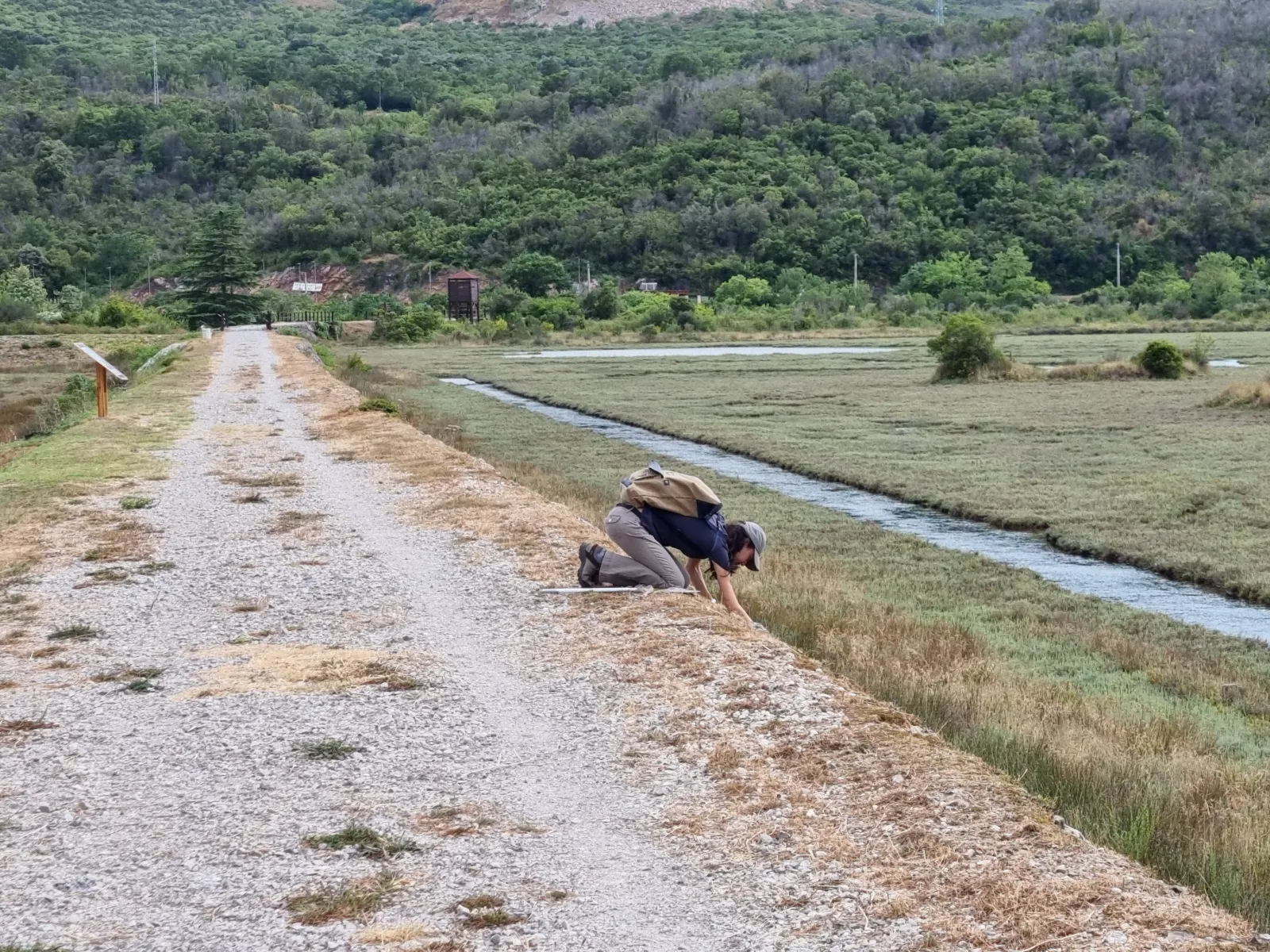
Photos: Amazing pictures of Jovana with her net, courtesy of Jovana Bila Dubaić.
P.S. I’ve included the script for this episode below.
Pema VO: Hey, I’m Pema and you’re listening to the Download. Episode two, ‘Wild City’.
Coming up, free-living bees, city beasts and, on Teatimers, Tashi Charli makes a difficult choice.
The Download is an audio magazine, so feel free to pause after listening to a feature, and come back to pick things up later on. Let’s turn the page.
Pema VO: Have you ever seen a beekeeping box? They are funnily shaped things, they do look like little houses, with different storeys chaotically stacked on top of each other. They have trays, and little doors so that the beekeepers can see into the boxes and look at the bees. They are large, usually standing on the ground. They are very cute little structures.
Beekeeping has seen a big resurgence as a hobby in recent years, and businesses in the cities even keep managed hives on the top of high-rise buildings.
These are managed honeybees, honeybees that have been bred and kept by humans. But in fact, there are still wild honeybee populations, and the way those wild populations live is very different to how we keep them. You can find them in the city too, hiding in holes and old logs.
I met someone interesting. A wild honeybee expert.
Jovana Bila Dubaić:
We also sometimes call them free-living bees.
Pema VO: That’s the voice of Jovana Bila Dubaić. Jovana lives in Belgrade, in Serbia, and is an assistant professor at the Faculty of Biology within the University of Belgrade. Jovana studies the ecology of bees, particularly wild honey bees.
JBD:
I'm really happy to talk with you about bees, my favorite topic.
Well, I enjoy my work so much. I cannot imagine myself studying any other group of animals.. I was always interested in animals and plants and nature. But I did not know almost anything about bees.
And then as a biologist, I always thought honeybees are a subject of someone who works in agriculture or I don't know, forestry or something like that. like biologists should study wild species, right? But then I was so wrong. Like only when I met my professor, my mentor,
and he's a bee expert, I realized how huge this world is of bees and how much we don't know about them and they are so important for the whole planet. mean, it's crazy how important they are and we don't know enough.
And this gateway of this hidden world opened up to me
Pema VO: Let’s crack open up that hidden world a little further. Let’s imagine, we’re sitting in a park in Belgrade, loads of other people around, the sun shining, a light wind, and then we see someone crouched over a little garden of flowers, holding a net.
JBD:
I usually do my field work in urban areas in Belgrade, in city parks, surrounded with people. And then often people approach ask me what am I doing with this entomological net and I'm looking at flowers for hours sometimes. And people approach and ask what am I doing? Is there something dangerous there? What am I catching?
Pema VO: By the way, Jovana shared with us an amazing photo of her, with her net, just as she describes, searching, searching for bees. You can find it at yoto.space/the download - there’s show notes with photographs. But back to Jovana, in the park, talking to other park-goers:
JBD:
I adore these conversations. You start talking to people and answering their questions.
They are surprised about a lot of things that I have to say, but when I tell them that majority of bee species live underground, digging tunnels in the soil, like, are you sure? Is that correct? And then they Google it.
There is this hidden world everywhere around us. It's not in this pristine nature somewhere in, I don't know. It's all around us in our cities, our school yards, our balconies, and of course also in pristine nature.
Pema VO: Did you catch that? The majority of bees live underground. Here are some other myths about bees - can we get a beat here?
That all bees live in colonies - in fact, many bee species are solitary.
All bees sting - some bees don’t have stingers at all!
Another good bee fact - bumblebees have been trained to play football - to play with tiny balls and put them into a goal.
Jovana also told me that kids often ask her if bees sleep.
P:
Bees do sleep, don't they? Yeah.
JBD:
Yes, they do sleep. Yes. The ones that live in hives, they group together and sleep. The ones that are solitary, they sleep sometimes in the flowers, sometimes in their little nest, depending on the weather. Yeah, it's really cute.
Pema VO: I’ll admit, I didn’t know those things a few months ago. Especially the football thing. And in fact, it turns out I knew barely anything about bees, despite having enjoyed watching bees in the garden my whole life. While reporting this story for The Download, I went on a whole journey into beedom - and into the complex and amazing world of bee study.
Here’s the biggest myth of them all, in my view - that all bees make honey. Actually, most species of bee are more concerned with pollination than honey! But the honey we eat comes from managed honeybees - managed honeybees are honeybees looked after by humans. There are also wild honey bees. How many times can I say honeybee? A lot more, we’ll find!
Jovana’s research focuses on those wild honeybees.
JBD:
They were there long before us, long before beekeeping.
Like they are the same species as the ones we keep in hives, but their way of living is totally different. And this is what got me curious.
Pema VO: Wild honeybees are the same species as managed honeybees but the ways they live are very different. They choose smaller cavities to live in because it saves energy.
And they also tend to live high up. Beekeepers keep managed honeybees on the ground, so that they can work with the bees. But this is also energy inefficient, with the temperature and humidity closer to the ground being more unstable.
JBD:
So if they can choose, they would always choose something above the ground, high in the canopy.
Also, like when we keep bees, we concentrate them in one spot. put 50, even more hives in one spot, also because it's more convenient to us.
And in nature, they also don't do that. They tend to spread in the area because they don't want to be competitors to one another.
So like all these, like when you study a species, this is what you look for. What do they eat? Where do they live? What do they prefer, et cetera. And when you compare how we keep them and what they choose for themselves, it's totally different.
Pema VO: SO is there a problem with this? What’s the problem with keeping bees, and making local honey?
Jovana says it’s complex.
JBD:
I don't want to point fingers and blame beekeepers because mostly they don't even know things can be negative for wild honeybees. But like I said, we tend to keep bees in a totally different way than how they want to live in nature. we like, when we apply medicine in beekeeping, when we give them artificial food, when we, you know, care for them, we actually make them weaker. We actually stop natural selection from doing its magic. And then we put these managed bees out there to reproduce with the ones that are maybe more resilient.
This is something we usually don't pay attention to. We just put hives somewhere. What are they going to eat? Are they going to be competitors for food for other pollinators?
Pema VO: This is the thing.
Honeybees are highly efficient foragers, Jovana told me. They often occur in very large numbers and they compete for floral resources - pollen.
Jovana said, when too many colonies of managed honeybees, those kept in those human-made hives, are concentrated in one area, other bee species are the first to suffer.
And part of Jovana’s focus on studying wild honey bees, is with the perspective that protecting and studying wild honeybees, can lead to employing more natural ways of working with managed honeybees, and creating a more balanced ecosystem for all local pollinators.
JBD:
Not all advances need to be something new that we invented.
No, we just need to slow down and look what they do in nature to survive. Mimic these conditions as much as you can. Spread them around. Don't pile them in one spot. This is how the pathogens and diseases spread really fast. this is how the beekeeping can be more sustainable in a long run.
Pema VO: I asked Jovana what we can do, people who live in neighbourhoods with bees buzzing around, to support pollinators.
JBD:
You can be more lazy gardener. This is one advice. We don't have to remove everything and make everything look nice when you look at it. Let's make habitats that are nice for us and nice for the bees.
Even flowers on your balcony or even on your window can, and I'm not saying this lightly, it can make a difference. Especially for smaller pollinators, they cannot fly far before taking a break or drinking a little bit of nectar. So your window with flowers can be crucial for them, especially in cities. So I always say to people like plant pollinator friendly flowers. Pay attention that you plant the ones that are native in your area. This is really important.
Pema VO: So, plant native pollinator friendly flowers. I know in my area you can buy mixed seed packets that only contain native seeds. Maybe you could look to see if something similar exists where you live?
JBD:
And also cities tend to be really neat. Like we tend to have everything clean around us. So we tend to remove all these materials from our gardens and parks that are not garbage, not trash. Like we tend to remove the stumps, the hollow logs or even fallen leaves, branches and stuff. Bees and other beneficial insects, they adore these things. Like leave the leaves alone. They will nest underneath. They will have insulation during winter, et cetera.
Pema VO: Leave fallen logs and leaves, stumps and branches. Got it. Jovana also tells me that an organisation she works with, Honey Bee Watch, often uses citizen scientists.
JBD:
We published monitoring protocol. It's open access. You can find it online that you can follow. It's like a list of questions that you can follow and answer to be like a real scientist. Like what do we do? What data do we want in order to find out more about free living honeybees out there? There is instructions when to visit them on what kind of weather conditions, what you look out for. I think it's really interesting. And I have a lot of citizen scientists in Belgrade that helped me monitoring wild honeybees.
And they really enjoy letting me know, bees are alive.
You just go out there, take photos, note down the activity, note down the weather conditions, did something in surrounding change and stuff. And for science, it's really priceless.
So just regular people, kids with their grandparents, I don't know, can help us a lot.
P:
Mm-hmm. I really like that because I think a lot of people think that science just happens in a lab. And it's nice. It's just exciting, I think, for people to learn that they can themselves be scientists out in the wild.
JBD:
I really like to talk to kids about this because kids are like the best educators later. They go home, they tell about it to their parents and grandparents and their friends. So I think in a way kids are the most important audience we can have. And they are the most curious ones.
Pema VO: I love what Jovana said there, kids are the best educators I totally agree. Thank you so much to Jovana, you can find more about her work at yoto.space/the download.
Jake: What animals do you see where you live? What’s your local wildlife like? For me, I have the birds in my garden - the pigeons, the house sparrows, the blackbirds. I often see a heron when I’m walking along the canal at the bottom of my road. There are some very tame squirrels in my local park, they come up close looking for nuts or any other treats. Foxes too, I see once in a while. Oh and then there’s the elephants…
Ha ha, yes you heard that right folks, about a 5 minute walk from my front door there are rhinos. Let me explain, you see where I live there is a zoo, a big zoo, the most popular one in the UK, Chester zoo. But I don’t have to actually go inside the zoo to sometimes see some of the animals - there is a public pathway that runs through the zoo, which is where I walk my dog, Dotty most mornings. And from there you can see not only elephants, but rhinos, leopards, deer, warty pigs, donkeys, gibbons and if you’re very lucky you might get a glimpse of the sun bear but that is a little bit shy, so sightings are rare.
In fact, not all of these animals are always out and about but sometime they are and when Dotty and I get to see them it’s very exciting
But whilst there are all these wild animals just a stone’s throw away from my house, I think I am just as excited by the local flora and fauna - ooh flora and fauna - let’s just check in with that phrase shall we?
Flora - all the plants in a region or environment.
Fauna - all the animals in a region or environment.
Looking at trees, flowers, birds, insects, and other things in nature is really good for you because it helps your brain and body in many ways. Watching leaves move in the wind or birds flying can make you feel calm and less stressed, like your worries are floating away. Flowers, bright colors, and interesting shapes can make you feel happy and curious, and noticing small details trains your brain to pay attention and focus. Listening to birds singing or insects buzzing can help you feel peaceful and more aware of the world around you. Even just noticing nature can make your heart beat a little slower, your breathing steadier, and your mood better. Over time, spending time observing plants and animals can make you feel more relaxed, more creative, and more connected to nature.
Pema VO: Hey, we're almost finished with this episode of the Download. But first we're going to slow down, take a breath, and get cozy to listen to today's instalment of our fiction serial, Teatimers. If you're ready to listen to the story, play on. If you need to come back later, no worries, hit pause and come back when you're ready.
Pema: Tashi charli and her mum walked to the local library. This was their Saturday routine - they’d go to the library together, her mum would write on her novel for an hour, and Tashi Charli would read and pick some books to take home. Then they’d go and get oat hot chocolates.
Okay Tash, mum said, you good to read while I write? She always asked this, even though Tashi Charli was absolutely always ready to read. And make sure you pick some out to take home.
Tashi was always allowed to take three books out per week. She had her own library card, which she’d signed with her own spikey signature. She’d practiced her signature for hours before signing, trying out different ideas, shapes, styles of writing her own name. There was always something she wanted to take home and curl up to read on the couch, her mum doing the same alongside. Two bookworms.
Today though, Tashi wasn’t sure what she wanted to read. She’d just finished an amazing book yesterday, about a gothic old manor house and a lady who lived there amongst the cobwebs. When she’d finished a book like that, sometimes it was hard to know what to pick up next.
Tashi Charli wandered the stacks, gently running her hands along the spines. There was a kids section, and she often still chose books from there, but she was old enough now to be curious about what happened in the rest of the library. That’s where she’d got that novel about the lady covered in dust and cobwebs, under D in fiction. And it’s where she was at that moment, though in W. There were a lot of books by someone called Woolf.
Out of the corner of her eye, she saw a little shape dash into the aisle. The librarian, a tiny willy wagtail, landed with a jerk on the shelf in front of Tashi.
Hello! Having trouble? Can I help? What are you looking for? The little bird spoke in sharp little notes, its head, smaller than a pingpong ball, twitching from side to side.
Um, thanks. Said Tashi. I’m not sure what to read next. My last book was too good, if you know what I mean.
Oh, I do! Said the Librarian. You know, people don’t think willy wagtails are big readers. But - the Librarian hopped up and down - I am! I like poetry, especially.
Oh, said Tashi, well you’re a librarian, I guessed you might like books.
Hmm! Well, good of you. Now. What can we find you. Let’s see. What do you like?
Well, said Tashi. Lots of things.
i like sewing
i like fairytales
i like deserts
i like castles
i like witches
and i like letters
i like fashion
i like historical costumes
i like cows and i like leopards
i like giants that look like mountains
i like ribbons
i like cooking
and mystery
and forgotten places
i like drawing
i like making things
Okay okay, said the librarian. What don’t you like?
Tashi Charli thought.
Hmm, space!
I’m not that into space. Like, going there. I do like the moon, and the stars. But i like them seen from earth, from my back garden.
Well! You know, that doesn’t much narrow it down. Let’s have a look.
The librarian made its jerky jumps shelf to shelf, sometimes landing on a book, which Tashi would pull out and take into her arms. After a few minutes, she couldn’t carry her any more.
Try those, the Librarian said, and Tashi Charli took the pile to an old couch.
She poured over them, reading a sentence in one book, flicking through another, sorting them into different piles. As she worked through the huge pile, she grew more and more agitated. All of them were interested. All of them looked good. There were simply too many books. How could she choose?
A swift, sharp movement caught her attention.
Trouble picking? The Librarian said, perched jauntily on a copy of One Hundred and One Dalmations.
Tashi Charli gave the Librarian a desperate look.
Listen, said the Librarian. There are an enormous amount of books in the world and you can’t possibly read them all. You can’t even read all the good ones! But! If you don’t pick one, the next one, if you’re stuck with indecision, you won’t read anything. You also have to choose! So, how about this? How do you wish to feel this week, when you read?
Oh, said Tashi. I would like to feel:
quiet, full of wonder and excitement
I’d like to laugh
and I’d like to feel like my brain is lit up with new ideas.
Do you know which books to take home now? Said the Librarian.
Yes! Said Tashi, and reached for the three books in the pile she believed would give her those feelings.
As they scanned out their books, Tashi’s mum picked up a book of myths and legends. Oh! She said, I read that one when I was your age! she says. I read it late into the night, I remember, way past my bedtime, under my doona, using a torch. And then I think I went to my window and looked at the moon and stars outside, and thought about long gone people gazing at them to, and telling each other those stories.
Later that night, Tashi Charli watched the night sky from her bed, and wondered at how people across time could share a feeling. Herself and her mother, and those old-world people, all looking at the stars.
You’ve been listening to the Download, written and hosted by me, Pema, and Jake. The Download is produced by Yoto, with sound design by Jack Beattie and original music by Tom McCarthy.